Wet brick in Broken Arrow: which problem you actually have, and when to call someone else
Written by the owner of Haikey Creek Masonry Waterproofing, Broken Arrow. Published 2026-09-29.
A wet brick wall is a symptom, and six different problems produce it on houses around Broken Arrow. Two of them are ours to fix, two are ours only after a mason has done something first, and two belong to a different trade entirely. We see owners pay for a coat of sealer on a wall that was leaking at a window head, and owners pay a foundation company for a slab line that only needed weep holes. This guide is the walk we do at the inspection, written out so you can do most of it yourself before you call anyone.
My brick is wet on the inside after it rains. What is actually leaking?
On a Broken Arrow brick veneer house the water is usually coming through one of six places: the slab line where there are no weep holes, open or crumbling mortar joints, a chimney crown or cap, the head of a window or door with no flashing, a crack from clay movement, or a face that is spalling because someone sealed it with a film. Which one you have decides the fix, and the fixes range from a $300 chimney crown patch to a $6,000 weep hole and flashing retrofit, so the sorting matters more than the sealer.
The tells are different for each one, and after a hard rain they are easy to read if you know where to look.
- No weep holes or flashing: a dark band across the bottom two courses that stays wet a day after the rest of the wall dried, usually on 1975 to 2005 houses. Interior baseboard on the outside walls goes soft.
- Failed mortar joints: water shows up in the middle of the wall, not the bottom. Joints crumble under a screwdriver, or you can see daylight through a head joint. Common on sand mortar from the 1980s and on south and west walls.
- Chimney crown or cap: staining on the ceiling or wall next to the chimney, a crown with visible cracks or a puddle on top, efflorescence on the chimney but nowhere else.
- Window or door head: a wet spot that starts at the top corner of an opening and runs down. The wall above it is dry. Steel lintels rust and jack the brick up.
- Clay movement crack: a stair step crack through the joints, wider at the top, on a house that also has a door that sticks in August. The Oklahoma red clay under the slab swells wet and shrinks dry.
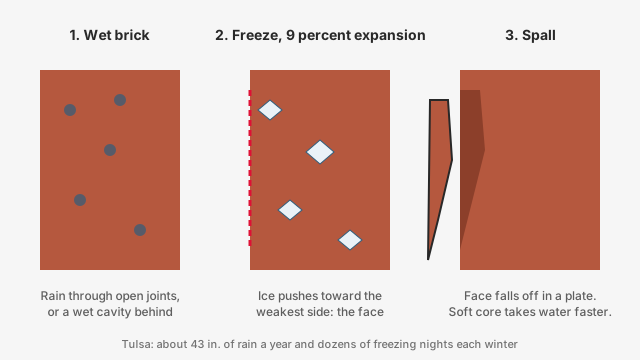
- Sealed with a film: the brick face is flaking or popping off in dime sized chips, and the wall was painted or sealed with something glossy in the last few years. The water is trapped behind the film, not coming through it.
How do I tell them apart in one walk around the house?
Start at the bottom of the north wall the morning after a rain and work up, because water shows lowest first and the north wall dries slowest. Five checks, ten minutes, no ladder for four of them.
- Look at the bottom two courses on every wall. Wet band along the base and nowhere else means the slab line, so check for open head joints every two to three feet. None, or joints packed with caulk or foam, means no drainage.
- Press a screwdriver into a mortar joint at chest height on the south and west walls. If it sinks in or the sand falls out, the joints are the leak, or at least a leak, and sealer alone will not hold.
- Look at every window and door head. A wet fan shape starting at a top corner, or a rust streak from the lintel, is a flashing problem at that opening, not a wall problem.
- Stand back and look for stair step cracks. Measure the widest point. Under an eighth of an inch is a repointing job. Over a quarter inch, or wider at the top than the bottom, is a foundation conversation first.
- Check the chimney from the ground with binoculars or a phone zoom. A cracked crown, a missing cap, or efflorescence only on the chimney means the water is coming in from the top and the wall below it is innocent.
Repoint, rebuild, or seal: which fix goes with which problem
Repointing fixes bad joints, a retrofit fixes a missing drainage path, and sealer only ever comes last, after the wall has been made sound and has dried out. The Brick Industry Association’s maintenance guidance says the same thing in more words: coatings do not fix defects, they protect a wall that has already been repaired.
Here is the match up we use, with the ranges from our published price table.
- Slab line wet, no weep holes: weep hole and flashing retrofit, $1,500 to $6,000 per house. Sealer afterward, never before.
- Joints crumbling on one or two walls, brick sound: repointing, $1,200 to $5,500 depending on wall area and depth. Then a penetrating silane and siloxane repellent, $1,000 to $3,500 per house.
- Joints gone and brick faces spalled over a large area: partial rebuild of the damaged courses, priced per square foot at the inspection. Repointing spalled brick is money spent twice.
- Chimney crown cracked: crown repair or recast plus a cap, on the chimney page. Do this before sealing anything on the chimney.
- Window head leaking: lintel and flashing repair at that opening. If the lintel is rusted through, the brick above comes out and goes back.
- Stair step crack under an eighth of an inch and stable: repoint and monitor. Wider, growing, or paired with sticking doors: foundation contractor first, then us to close the crack after the slab has been stabilized.
- Film coated brick that is flaking: strip the film where it will come off, let the wall dry a season, repoint what the spalling exposed. Sometimes the answer is that the face is gone and those courses get rebuilt.
What should I watch for when I am getting bids?
The cheapest bid on a wet brick wall is almost always a sealer only quote, and it is cheap because it skips the diagnosis. Five things that should make you slow down.
- Nobody ran water on the wall. A hose test with a moisture meter is how you find the entry point. A quote written from the driveway is a guess.
- The quote is sealer only, on a wall with soft joints. Repellent on open joints does nothing, and a film sealer on a wet wall spalls the face. Ask what happens to the joints first.
- The product is not named. You should know whether it is a penetrating silane and siloxane repellent or a surface film, because one breathes and one does not, and that decides whether your brick survives the next freeze.
- No mortar match. New mortar that is harder than the old brick cracks the brick instead of the joint. Ask what type of mortar and why.
- No written scope by wall. A price per house with no square footage or wall list cannot be compared to anything, and it hides what was left out. Our cost page shows what a scope should list.
Who we are not the right fit for
We waterproof brick, stone and block above grade, and there are calls where the right answer is a different company. A crack over a quarter inch wide, or any crack that reopens after repointing, is a foundation problem and a slab pier company needs to see it before we touch the brick. Water in a basement or crawlspace coming up through the floor is below grade drainage, a different trade with different equipment. A roof leak that happens to run down a chimney or a wall belongs to a roofer, and we will say so at the inspection rather than seal the wall below it. Interior mold remediation is not our work either, though we will fix the wall that fed it. And if you want the brick painted for looks, a painter is cheaper and we would talk you out of a film coating anyway. What we do is find where the water is getting into the masonry, on houses and small commercial buildings from Broken Arrow out to Owasso, Bixby and Coweta, and fix that.
Sources
Questions this guide gets
- Can one house have more than one of these at the same time?
- Usually it does. A 1985 house with no weep holes almost always has some soft joints too, and the clay has usually opened a crack somewhere. The inspection lists them separately with a price each so you can decide what to do this year and what can wait.
- Is the inspection free?
- The hose test and moisture meter visit is $125 to $175 and is credited back if you hire us. It takes about an hour and you get a written list of what is leaking and what is not.
- How fast does a wet wall dry out once the leak is fixed?
- A brick veneer wall that has been wet for years takes a full dry season, roughly two to three months of Oklahoma summer, before it is ready for a repellent. Sealing it earlier traps the water.
- My wall is only wet after a southwest storm. Does that tell you anything?
- Yes. Wind driven rain from the southwest is what pushes water through joints and the brick face. A wall that leaks only in those storms is usually a joint or window head problem, not a slab line problem, since the base course gets wet in any rain.
Have us look at your wall
Address, then what you see. A range off the published table and a time for the hose test.