Brick and stone sealing in Broken Arrow
Published pricing · Call (918) 362-4398
Sealing the brick on a Broken Arrow house costs $1,000 to $3,500, which works out to $1.50 to $3.50 per square foot of wall, and it takes one day for most single-story homes. The product is a penetrating silane and siloxane water repellent, not a film. It soaks an eighth to a quarter inch into the brick and mortar, bonds to the minerals there, and makes the wall shed rain while still letting water vapor out. That last part matters in our climate. A film sealer or a coat of paint over brick traps the moisture that our wet springs push into the wall, and when it freezes in January the brick face pops off. We hose test the wall before quoting, repair any open joints first because sealer over an open joint is wasted, and the repellents we use carry a 10 year manufacturer warranty against water absorption.
What you are probably seeing
- Brick that darkens and stays dark for a day after rain on the north and east walls
- Sand-faced or wire-cut brick from the 1970s and 1980s that feels chalky when you rub it
- Mortar joints that have gone from gray to green with algae on the shady side
- A brick or stone front you just had repointed and want to keep that way
- Old paint or a glossy sealer peeling off the brick in sheets
- Interior drywall that bubbles or stains on an outside wall after a storm
Repellent, not sealer: why the wall has to breathe
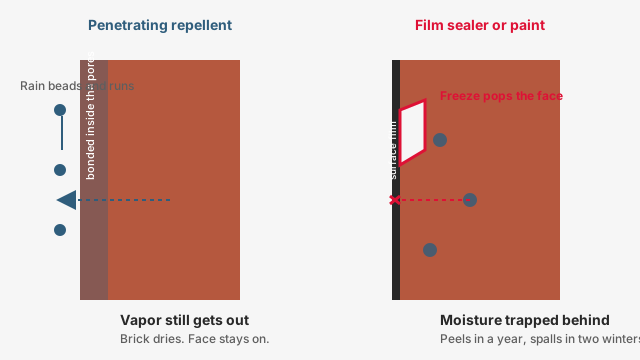
Brick and mortar are full of tiny pores, and that is how they are supposed to work. Rain wets the surface, some of it soaks in, and dry air pulls it back out over the next day. Trouble starts when the amount going in is more than the wall can give back before the next storm, or before a hard freeze. That is where a water repellent earns its keep. A silane and siloxane blend lines the pores so liquid water cannot get past the surface, but the pores stay open to vapor, so whatever moisture is already in the wall can still leave.
A film-forming sealer does the opposite. It closes the surface completely, looks great for a season, and then any water that arrives from behind the wall, at the slab line, or through a hairline crack has nowhere to go. It sits under the film, freezes, and takes the brick face with it when it lets go. The Brick Industry Association has said for decades that only breathable repellents belong on exterior brick, and every wall we have stripped of a peeling clear coat in Broken Arrow proves the point.
What happens before any product goes on
A repellent only protects a sound wall, so the visit starts with a hose and a moisture meter. We run water down each elevation for a few minutes and read the meter inside and at the base course. That tells us whether the wall is drinking through the brick face, through open joints, or at the slab line where the weep holes should be. Those are three different fixes, and only the first one is solved by sealer alone.
If joints are cracked or missing mortar, they get repointed first and cured for a few days. If the base course is wet from below, we talk about weep holes and flashing before we talk about sealing, because sealing a wall that is wicking from the slab just moves the moisture somewhere less visible. Then the wall gets a low-pressure wash to lift dirt and efflorescence, dries for a day, and the repellent goes on with a low-pressure sprayer in two passes until the wall stops taking it.
How long it lasts in Green Country weather
A properly applied silane and siloxane repellent on brick lasts 10 to 15 years here. South and west walls that bake all summer and take the wind-driven rain from the southwest lose it a little faster than the north side. The manufacturer warranty is 10 years against water absorption and we put that paperwork in your hands at the walk-through, along with the batch numbers of what went on the wall.
Cost per square foot depends mostly on how much the brick drinks. Dense modern face brick takes one pass and lands at the low end. Soft, sand-faced brick from the 1970s can take twice the product and sits at the high end. Two-story walls add ladder and lift time. A single-story ranch with 1,100 square feet of masonry wall usually lands between $1,600 and $2,500 all in.
How the work goes, step by step
- 1
Hose test and moisture readings
We wet each wall and read where the water goes. $125 to $175, credited back if you hire us for the job.
- 2
Written range off the cost table
You get the square footage, the product, the joint repairs if any, and one number range, in writing, before we schedule.
- 3
Repair first
Open joints repointed, spalled brick replaced, weep holes added if the base course is wet. Sealer over damage is money thrown away.
- 4
Wash, dry, apply
Low-pressure wash, a dry day, then two flood coats of repellent until the wall stops absorbing.
- 5
Walk-through and warranty
We spray a hose on the finished wall with you watching and hand over the 10 year manufacturer paperwork.
What it costs
Off the same table as everything else. The full cost guide has all twelve rows and the permit notes.
| Job type | Typical range | What moves the price |
|---|---|---|
| Leak source inspection with hose test and moisture meter | $125 to $175per visit, credited back if you hire us | Two-story walls that need a ladder on every elevation, and chimneys we have to get on the roof to test |
| Brick and stone water repellent (silane and siloxane penetrating sealer) | $1,000 to $3,500per house ($1.50 to $3.50 per sq ft of wall) | Wall area, two-story access, how much repointing has to happen first, sand-faced or soft brick that drinks more product |
Get a price for this job
Address first, then what you see. We reply with a range off the table and set a time for the hose test.
Questions about brick and stone sealing
- How much does it cost to seal a brick house in Broken Arrow?
- Between $1,000 and $3,500 for the whole house, or $1.50 to $3.50 per square foot of masonry wall. A single-story ranch usually lands between $1,600 and $2,500. Two stories, soft brick, and joint repairs push it toward the top.
- Will sealing change how my brick looks?
- No. A penetrating silane and siloxane repellent dries invisible and does not add gloss or darken the color. If someone shows you a shiny sample, that is a film-forming product and we will not put it on your wall.
- Can you seal brick that has been painted?
- Not through the paint. A repellent has to reach bare brick to bond. If the paint is peeling we can strip it and seal, and if it is sound we can talk about a breathable masonry paint instead.
- How soon after rain can you apply it?
- The wall needs about 24 hours of dry weather first and no rain for 6 hours after. In a Broken Arrow spring that sometimes means we call the morning of to confirm.
- Does sealing stop water coming in at the bottom of the wall?
- Usually not, because that water is coming from the slab line or from missing weep holes, not through the face. The hose test tells us which, and we would rather find out before you pay for sealer.