Weep hole and slab-line leak repair in Broken Arrow
Published pricing · Call (918) 362-4398
A weep hole and flashing retrofit on a Broken Arrow brick veneer house costs $1,500 to $6,000, depending on how many feet of base course have to be opened up, and it is the fix for water that shows up inside at the bottom of an exterior wall after a storm. Brick veneer is a rain screen, not a waterproof skin. Rain is supposed to get behind it, run down the air gap, hit a flashing at the slab, and drain back out through weep holes every 33 inches. Most houses here built before the early 2000s have no flashing at all and the weep holes were either never cut or were mortared shut. So the water pools on the slab edge, soaks the sill plate and the drywall, and feeds the efflorescence and spalling on the outside. We open the base course, install flashing that turns the water out, cut weep holes, and reset the brick.
What you are probably seeing
- Wet carpet or baseboard along an outside wall the morning after a heavy rain, with no plumbing nearby
- Drywall that stains or bubbles in the bottom six inches on an exterior wall
- No small openings you can see in the vertical joints of the bottom course of brick
- A musty smell in a closet or behind furniture on the north or east wall
- White salt crust or flaking brick on the lowest three courses outside
- Water in the garage where the slab meets the brick, after the driveway sheets rain toward the house
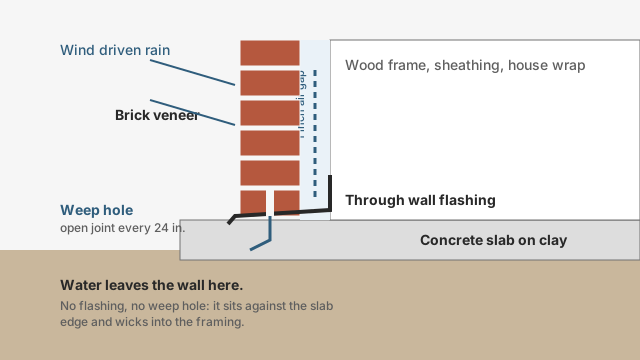
How a brick wall is supposed to drain
The brick on almost every house in Broken Arrow is a veneer: a single layer of brick standing an inch off a wood-framed wall, tied to it with metal straps. Wind-driven rain gets through brick and mortar, that is expected, and it runs down the back of the veneer inside the air gap. At the bottom, where the veneer sits on the slab, a piece of flashing is supposed to catch that water and turn it back out through open vertical joints called weep holes. The International Residential Code has required flashing and weep holes at that point for years, and the Brick Industry Association has published the detail since the 1960s.
What actually got built through the 1980s and 1990s here was often brick straight on the slab, no flashing, and either no weep holes or holes that a painter or a landscaper filled in later. When we open the base course on those houses the sill plate behind it is damp, and sometimes it has been damp for decades.
What the retrofit involves
We cut out the bottom course of brick in sections of about four feet, clean the slab edge, and lay in a flashing that laps up behind the sheathing wrap and out over the front edge of the slab. Then the brick goes back with open head joints every 33 inches and a mesh weep insert in each so insects stay out. On a walk-out or a garage front where the driveway slopes toward the house we sometimes add a small drainage mat in the air gap so mortar droppings cannot block the new weeps. The wall gets sealed with a breathable repellent afterward so less water is getting in to begin with.
If the clay around the slab stays saturated for weeks after rain, the wall will keep wicking from below no matter how good the flashing is. That is when a French drain along that side of the house, tied into the same work, makes sense, and it is priced separately on the cost page.
Cheap fixes to try first
Before we open a wall we look at three things that cause the same symptom for a lot less money. Downspouts that dump at the foundation, especially on a corner, put more water against the base course than any storm. Extending them six feet solves a surprising number of wet-wall calls. Grading that slopes toward the house or mulch beds piled above the weep line hold water against the brick. And sprinkler heads aimed at the wall soak the bottom courses every night all summer. We will tell you if one of those is the problem and let you fix it yourself.
How the work goes, step by step
- 1
Hose test at the base course
We flood the wall and watch inside with a moisture meter. If the wall is wet at the bottom but dry above, it is a slab-line problem.
- 2
Check the cheap causes
Downspouts, grading, mulch, sprinklers. If those are the problem we say so.
- 3
Open the base course
Bottom course removed in four-foot sections, slab edge cleaned, old debris cleared from the air gap.
- 4
Flash and weep
Flashing installed and lapped behind the wrap, brick reset with open head joints and weep inserts every 33 inches.
- 5
Seal and verify
Breathable repellent on the elevation, then a second hose test with you watching the weeps drain.
What it costs
Off the same table as everything else. The full cost guide has all twelve rows and the permit notes.
| Job type | Typical range | What moves the price |
|---|---|---|
| Leak source inspection with hose test and moisture meter | $125 to $175per visit, credited back if you hire us | Two-story walls that need a ladder on every elevation, and chimneys we have to get on the roof to test |
| Weep hole and slab-line flashing retrofit | $1,500 to $6,000per house | Linear feet of base course, whether any flashing was ever installed, cutting out and resetting the first course of brick |
| Stair-step and foundation-edge crack repair | $900 to $3,500per crack run | Whether the crack is still moving with the soil, length, whether a control joint has to be cut so it stops reopening |
| Drainage-tied waterproofing (French drain along a masonry wall plus repair and sealing) | $6,000 to $15,000per side of the house | Linear feet, where the water can legally discharge, landscaping in the way, how deep the clay stays wet |
Get a price for this job
Address first, then what you see. We reply with a range off the table and set a time for the hose test.
Questions about weep hole and slab-line leak repair
- How much does a weep hole retrofit cost in Broken Arrow?
- Between $1,500 and $6,000 per house. One wet wall on a ranch is usually $1,500 to $2,500. All four sides of a two-story with flashing that was never installed lands near the top.
- How do I know if my house has weep holes?
- Look at the bottom course of brick for small open vertical joints, about the width of a pencil, every three feet or so. If you see none, or they are filled with mortar or caulk, the wall has no way to drain.
- Can I just drill weep holes myself?
- Drilling holes helps a little, but without flashing behind them the water that reaches the slab has no reason to go out the hole instead of into the sill plate. The flashing is the part that does the work.
- Does this fix the water in my garage?
- If the water is coming through the brick above the slab, yes. If the driveway is pouring water under the garage door or through a crack in the slab itself, that is a different fix and we will tell you.
- Will the reset brick match?
- It is your own brick going back in the same spots, with mortar matched to the existing joints. The only visible change is the small open joints at the bottom, which is how the wall should have looked from the start.