Retaining wall and stone wall drainage in Broken Arrow
Published pricing · Call (918) 362-4398
Fixing the drainage on a block or stone retaining wall in Broken Arrow costs $2,500 to $9,000 per wall, and it is the job that saves the wall from having to be rebuilt. A retaining wall does not fail because the block was weak. It fails because water built up in the clay behind it, the pressure doubled, and the wall leaned, cracked or blew out its lowest course. The fix has three parts: a gravel drainage zone and a perforated pipe behind the wall that runs to daylight, weep drains through the wall every few feet so water in the backfill has a way out, and a breathable repellent on the face so rain stops soaking in from the front. On a wall that has already leaned more than an inch per foot of height we will tell you honestly whether drainage alone will hold it or the wall needs to be rebuilt with the drainage done right this time.
What you are probably seeing
- A block or stone wall that leans out at the top, or bows in the middle of a long run
- Water seeping through the face or pooling at the base of the wall for days after rain
- White efflorescence bands across a retaining wall, worst near the bottom
- Mortar joints washed out on a stone wall along a creek or drainage easement
- A horizontal crack along one course, or the top course popping loose
- Soil settling in the bed behind the wall, or a sinkhole forming behind it
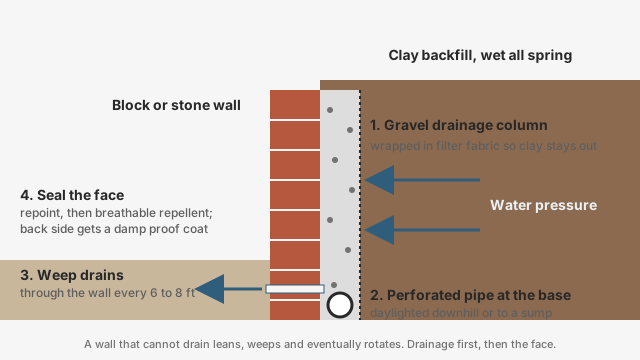
Why the clay behind the wall is the enemy
Broken Arrow backfill is usually the same clay the wall was dug out of, and clay holds water like a sponge. After a week of spring rain the soil behind a four-foot wall can weigh twice what it did dry, and all of that pushes on the block. A wall built with no gravel zone and no drain pipe behind it is fighting that pressure every year. The walls along Haikey Creek and the drainage easements south of 101st Street show this best: the ones with drainage are still straight after 25 years, and the ones without are the calls we get.
What a proper drainage retrofit looks like
We excavate behind the wall to the footing, lay a filter fabric, set a four-inch perforated pipe at the base with a fall to a daylight outlet or a dry well, and backfill with clean gravel to within a foot of the top. Weep drains get cored through the wall every four to six feet at the base so water in the gravel can also leave through the front. Then the soil goes back with the fabric folded over the gravel so fines cannot clog it. On the face, joints are repointed where they have washed out and the whole wall gets a silane and siloxane repellent so it stops absorbing rain and losing mortar to freeze-thaw.
For a stone wall along a creek bank, we also look at where the water is coming from at the top. A downspout or a yard drain that discharges behind a retaining wall is the cause we find most often, and moving it is cheap.
Repair or rebuild
A wall that leans less than about an inch per foot of height, has no broken block, and has a sound footing can be saved with drainage and repointing. Past that, or if the bottom course has crushed, the wall needs to come down and go back up. When we rebuild we build the drainage in from the start, use geogrid in the backfill on anything over four feet, and the city may require an engineered design at that height. We will tell you which side of that line your wall is on after the first visit.
How the work goes, step by step
- 1
Measure the lean and probe the backfill
We check plumb along the wall, look for a footing, and dig a test hole behind it to see whether there is any gravel or pipe.
- 2
Find the water source
Downspouts, yard drains, sprinklers and grading above the wall get checked first, because moving one is cheaper than anything else on this page.
- 3
Excavate and drain
Backfill removed to the footing, fabric, perforated pipe to daylight, clean gravel, weep drains cored through the base.
- 4
Repoint and seal the face
Washed-out joints repacked, then a breathable repellent on the whole face.
- 5
Backfill and grade
Fabric folded over the gravel, soil returned, and the surface graded so water runs along the wall, not into it.
What it costs
Off the same table as everything else. The full cost guide has all twelve rows and the permit notes.
| Job type | Typical range | What moves the price |
|---|---|---|
| Leak source inspection with hose test and moisture meter | $125 to $175per visit, credited back if you hire us | Two-story walls that need a ladder on every elevation, and chimneys we have to get on the roof to test |
| Mortar joint repointing and tuckpointing | $1,200 to $5,500per job ($8 to $20 per sq ft of wall) | Joint depth, matching a 1980s buff or gray mortar, scaffold height, how many bricks have to come out and go back |
| Retaining wall drainage and sealing | $2,500 to $9,000per wall | Height and length, whether weep drains exist, how much backfill has to come out, block versus stone |
| Drainage-tied waterproofing (French drain along a masonry wall plus repair and sealing) | $6,000 to $15,000per side of the house | Linear feet, where the water can legally discharge, landscaping in the way, how deep the clay stays wet |
Get a price for this job
Address first, then what you see. We reply with a range off the table and set a time for the hose test.
Questions about retaining wall and stone wall drainage
- How much does it cost to fix a leaning retaining wall?
- Drainage, weep drains and sealing run $2,500 to $9,000 per wall depending on length and height. A rebuild with drainage built in usually costs $60 to $120 per square foot of wall face. We tell you after the first visit which one your wall needs.
- Can a retaining wall be straightened?
- A block wall that has leaned cannot be pushed back. If the lean is small, drainage stops it from getting worse. If it is past about an inch per foot of height, the wall comes down and goes back up plumb with drainage behind it.
- Do I need a permit for a retaining wall in Broken Arrow?
- Repairs and drainage work on an existing wall do not. A new or rebuilt wall over four feet tall usually needs an engineered design and a permit, and we handle that as part of the job.
- Why is there white staining on my retaining wall?
- Water is moving through the block from the backfill and leaving salts on the face. It means the wall has no working drainage behind it. Cleaning the stain without adding drainage just gives you a clean wall to watch it come back on.
- Will you seal a wall that has water behind it?
- Not until the drainage is fixed. Sealing the face of a wall that is saturated from behind traps that water in the block and speeds up the spalling. Drainage first, sealing last.