The white powder on your brick, explained
Written by the owner of Haikey Creek Masonry Waterproofing, Broken Arrow. Published 2026-09-27.
The white crust on a brick wall is efflorescence: salts dissolved out of the mortar, the brick or the ground by water moving through the wall, left behind on the face when that water evaporates. It is not mold and it is not paint failure, and on its own it is harmless. What it tells you is that water is passing through the masonry, and in Broken Arrow that usually means either rain getting in through open joints on a weather wall or ground water wicking up from wet clay at the slab line. Cleaning and sealing an elevation runs $800 to $2,500, but if the water source is not fixed first the powder is back by the next spring.
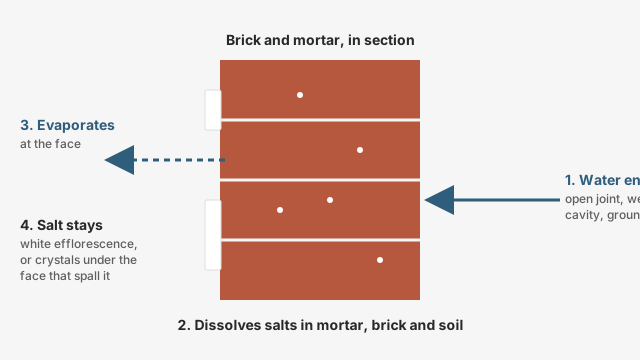
Where the salts come from
Portland cement mortar carries soluble sulfates and alkalis. Some brick does too, especially the softer sand faced brick used on 1970s and 1980s houses here. Clay soil and the fill under a slab hold more. Water dissolves the salts wherever it enters, carries them toward the drying surface, and leaves them as crystals when it evaporates. A wall that gets wet and dries often, which describes every south and west wall in Green Country, builds up the most.
The pattern tells you the source. Efflorescence in a band along the base course is ground water or a wet cavity with no weep holes. A bloom under a window or along a rusted lintel is a leak at that opening. A whole elevation lightly frosted after a wet winter is rain through open joints.
Why cleaning alone does not work
Scrubbing removes the crystals on the surface. It does nothing about the water path, so the next wet and dry cycle brings more salt to the face. Worse, pressure washing an old soft brick drives more water into the wall and erodes the joints, which is the opposite of what you want. Acid washes can etch the brick face and leave a permanent haze.
The right order is to fix the water path, let the wall dry through a warm spell, then clean with a mild proprietary efflorescence cleaner and a stiff brush, rinse from the bottom up, and seal with a breathable repellent once dry.
The crystals that damage brick
Surface efflorescence is cosmetic. Subflorescence is the same salt crystallizing just under the face of the brick, and it is not. The crystals grow with enough pressure to pop the face off, which is why a brick with a long history of efflorescence eventually spalls. Freeze and thaw does the same thing with ice. Both are why a wall with white bloom on it needs the water stopped before it needs the bloom cleaned.
What it costs
Cleaning and sealing one elevation is $800 to $2,500 depending on how much wall is coated and how gentle the brick needs us to be. If the source is open joints, repointing at $1,200 to $5,500 comes first. If it is a wet base with no weep holes, the retrofit is $1,500 to $6,000. Every number is on the cost page, and the hose test visit tells us which one applies before anybody quotes.
Sources
Questions this guide gets
- Is efflorescence a sign of a foundation problem?
- Not by itself. It is a sign of water moving through the wall. When it shows up along with stair step cracks and doors that stick, the clay under the slab is moving and both problems share a cause.
- Will sealing the brick stop the white powder?
- Only after the water source is fixed. A repellent keeps rain out of the face. It does nothing about water coming from the ground or a leaking lintel, and sealing a wall that is wet behind traps salt and water inside where it does more harm.
- Can I clean it myself?
- Light surface bloom on a modern hard brick comes off with a stiff dry brush and a rinse. Old soft brick, heavy crust, or bloom that keeps returning is worth a visit, because the cleaner and the water source both need judgment.
- Does new brick get efflorescence?
- Yes, often in the first year as construction water leaves the wall. That usually stops on its own. Bloom that appears years later on an established house is a water path, not new construction moisture.
Have us look at your wall
Address, then what you see. A range off the published table and a time for the hose test.